Wednesday, July 3, 2019

Kyoto Day 3

Our third day in Kyoto was probably our busiest day of them all. We bought a day subway and bus pass, so we didn’t end up paying an absurd amount in fees to get from one spot to the next. We started by going further out of the city to an area called Arashiyama to see Kinkaku-ji. Kinkaku-ji is a golden temple built on the edge of a pond. We got there right as it opened because we knew it would be busy. It was truly a spectacular sight with the temple reflecting onto the water. The entrance led you to the opposite side of the pond to view the temple before looping back around to the backside of the temple for a closer look. The original temple was built in 1397. A monk who was obsessed with it burned it down in 1950. It was rebuilt in 1955. The rest of our time at Kinkaku-ji was spent wandering through a short path on the grounds. We passed a couple of other waterfalls and another pond. All of this had a beautiful mountain backdrop.

Front gate at Ninna-ji.
Next, we took the bus a couple of streets down to Ninna-ji temple. We decided that it was not worth it to pay to go in, but were able to walk around the grounds for free. I do wish that Kyoto offered some type of pass that you could pay a base rate for and see as many temples and shrines as you would like. It gets rather pricy when each temple/ shrine costs anywhere from 4-10 dollars and you’re going in multiple temples each day.

Photo of the Cloud Dragon as we could not take any. 
From here we headed out to Tenryu-ji temple where the Cloud Dragon is located. Again, we decided to skip the main temple and temple gardens. We were not given the option to walk around for free here. We did however go into the temple that contained the Cloud-Dragon on the ceiling. Dragons are seen as the Asian symbol of Wisdom, and it is traditional to have them painted on the tops of certain types of temples. The temple was originally built in 1339 and has been burnt down a total of eight times. I’ve decided that the buildings here don’t have enough historical context if they haven’t been burnt down or destroyed at some point. The dragon that we saw was repainted in 1997 after it was decided that the previous dragon could not be restored. The Cloud Dragon is similar to the Mona Lisa in that it seems to be looking at you no matter where you stand in the building. This is because the dragon’s left eye is directly in the center of the painting. It was quite the sight to behold.


Our last stop in this area was at the Bamboo Grove. There was a walking path with towering bamboo trees to block out the sun and provide some shade. Just like the Torii gates from the previous day, the pathway was crawling with people. Unfortunately for us, it was not built into the side of a mountain, so it was crowded from beginning to end.


After lunch, we made our way to Yasaka Pagoda before heading to Nanzen-ji temple. We just passed by the Pagoda snapping photos. The streets here were lined with shops and filled with tourists. It is very popular to rent Kimonos in Kyoto. There were tons of women dressed in Kimonos taking photographs of themselves with temples in the background to commemorate the occasion. I’m not sure how many photos we ended up photo-bombing, but I’m guessing it was pretty high.


Looking at Dharma Hall from the trail. 
Nanzen-ji is home to Dharma Hall, a beautiful building built into the mountainside. We went inside and waited in line to view some fabulous statues. Unfortunately, you couldn’t take any photos of the statues, but everything else was fair game. There was a viewing platform overlooking the trail below the hall and the rest of the mountainside. We meandered down the rest of the trail. Scott did run up to the Easy Childbirth Pagoda and said it was pretty cool.


From here, we decided to try to make it to two last temples before they closed for the day. We hopped on the bus only to discover that Saturday afternoons can be quite busy in Kyoto. The first of the last two temples we tried to get to was closed and had the gates closed so that nobody could wander through the grounds. The last temple, Kodaji was closed too, but the grounds were open. We wandered around them and found an old aqueduct. This was really awesome to see. We were even able to see the water rushing through it from above when we climbed a staircase to check out a two-story pagoda partially hidden by the trees. We meandered our way back out to the front gate, stopped for some photos, and started heading back to the bus stop.


I really wanted to see a Geisha while we were in Kyoto, but everything I read said you would have to pay top dollar and have some sort of sponsor to get into a restaurant where they performed. Instead, we stopped close to the area that they were located to look for dinner. We ended up accidentally finding the bar Sama Sama which was mentioned in our guidebook. Its owned by an Indonesian man and served some delicious food. Lynsey and I busted out our very rusty basic Bahasa despite the owner speaking English. We shared beef rendang, nasi goreng (fried rice), and ayam baroda (spicy chicken). It was a fantastic way to end our day.

Kyoto Day 2

For our second day in Kyoto, we were a bit more organized thanks to Scott. We told him the sights we wanted to see, and he figured out the best way to navigate ourselves to that location. We started the morning by visiting Nijo-jo Castle, which was a fairly quick jaunt from our hotel. In my opinion, this has been the least impressive castle that we’ve visited. Instead of being built on a hill with a huge foundation made up of stonewalls, this was a sprawling one story structure. Tokugawa Ieysu built the castle in 1603.

Nijo-jo Castle
At Nijo-jo, we did get to see what a guardhouse would have looked like. None of the other castles that we’ve been to so far have had one. As with most castle and temple related structures, it was a fairly large building. There used to be nine guardhouses at Nijo-jo with two groups of fifty samurai guarding the castle at all times.

We made the decision to not go into this castle to save time and money and instead just walked around the grounds. There were plenty of sights to see around the grounds with lots of explanations of what everything was and why it was significant. At some point, I realized that a lot of the descriptions said ‘Important Cultural Significance’ or something similar to that phrase. I’m surprised it took me so long to recognize this as everything in Japan is very old, and all the buildings and everything contained within them can be traced back for centuries.

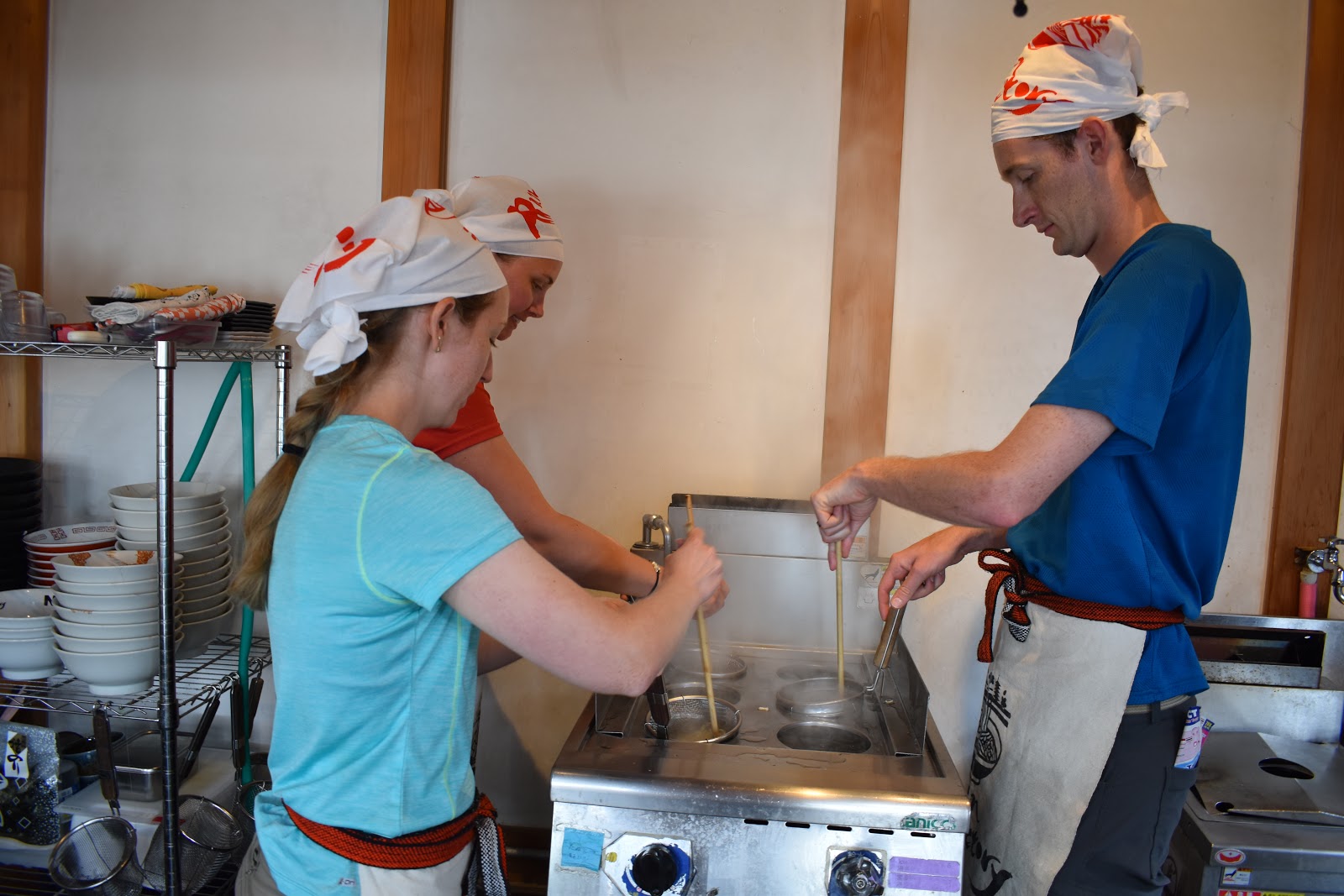
Dressed & ready to become Ramen masters!
After spending some time wandering around the grounds, we made our way to the Ramen Factory for our ramen noodle cooking class. I was super excited about this class and was really looking forward to enjoying my ramen. I got the class where we made ourselves the whole soup and not just the noodles. We began by rolling and tying our chicken up so that it could be boiled. Our chef took care of this for us.

Next, we were given the ingredients for the ramen: flour and saltwater. We sifted the flour, made a mountain, put a hole in the center, and poured 1/3 of our salt water into the flour to start mixing. We poured the rest of the water in in two batches while continuing to stir/ mix with our hands. Once everything was mixed, we took it out and began kneading it before doing the 100 punches and kneading. We had to flatten the dough out a bit, punch it 20 times, knead once, and repeat until you got to 100. I decided I’m pretty much a wimp because my hand did not enjoy that experience, and I didn’t punch it nearly as hard as what our chef showed us.

Then, we rolled it into a snake and flattened it before using a machine to flatten it even more. Each of us rolled our noodles through the machine twice to get thinner noodles. The last step with the noodles before cooking them was to put them through the part of the machine that cut them.

Cooking our noodles.
Before we could cook our noodles, we were given back our chicken. We had to cut the string off and cut it into pieces. We were then given a torch to do a final cook on our chicken. You could use the torch as much or as little as you liked. If you wanted the skin to be crispy, then you used it more. If you were like me and had no plans to eat the skin, then you used the torch as a novelty. We also had to mix our soup base. We could choose between chicken or fish broth or use a combination of either. Then you chose your flavorings: Miso, soy sauce, or salt. Our chef took these to put on the stove for a quick boil.

Finished product
We were finally ready to cook our noodles. They had what looked like a fryer filled with boiling water and baskets. We placed our noodles into the baskets and stirred the noodles for 50 seconds. We drained them and gave them a couple of good shakes. We added the noodles to our bowls, dumped our broth mixture on top, and returned to our table to add the chicken and whatever other toppings we desired. The noodles were absolutely delicious. I used a bit too much miso mix in my broth, so that it was too salty to eat by itself, but it did add delicious flavoring to my noodles. Overall, I’d say the cooking class was a hit with everyone.

We did learn that the temple that the cooking class was across from was closed to the public because some diplomat from the G20 summit was visiting. There were three police busses that we could see in the parking lot and a heavy police presence on the street in front of it. Luckily we were still able to pass to get to the class and back to the train station.

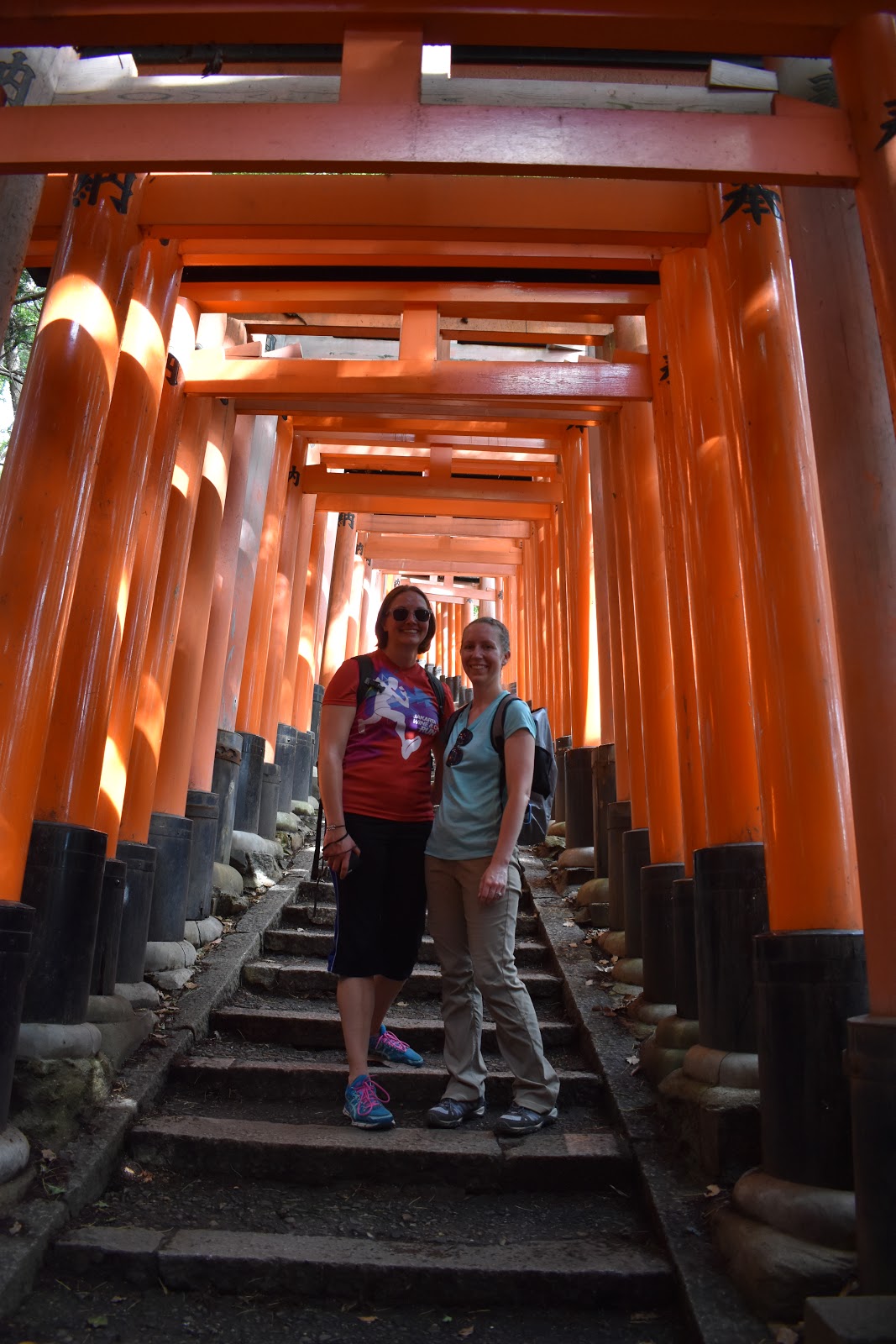
After the class, we set off in search of some bridges that Scott wanted to see. He was rather disappointed as they weren’t much to look at. So, we headed straight for Fushimi Inari Taisha. Besides Himeji-jo Castle, this has probably been one of my favorite experiences. There are thousands of Torii, shrine gates, at this complex. They are placed right next to one another, so that it gives a sense of having a roof overhead. There are walking paths underneath them. The paths close to the entrance are very crowded with people gawking at the Toriis and taking photos of themselves dressed in their Kimono rentals. The further up the mountain you go, the more the people thin out.

We decided to go to the top. There are tons of tiny shrines along the way. The tree coverage and shadows from the Torii give it a mysterious air. The fox statues standing guard at the entrances to the shrines and start of the Torii gates don’t make it any less mysterious. The fox is considered a messenger of the gods, and the Japanese view them as sacred creatures rather than sly and cunning.

The hike up to the top of the mountain was 4km along a paved walkway under the Toriis. Close to the top, there were a couple of different trail options, and thankfully the owner of a shop pointed us up the easier trail. We took the opposite trail back down and were very glad that we didn’t have to hike it up!

By the time we got back down it was getting to be late in the afternoon. We headed back to Kyoto station and decided to have dinner there. We had a second meal of noodles for the day and topped it off with ice cream on our way back to our hotel. I’m not sure what kind of ice cream we got, but it wasn’t vanilla. It actually was pretty good once you got used to the idea th


Friday, June 28, 2019

Kyoto Day 1

Yesterday we arrived in Kyoto after a minor mishap in the subway system in Osaka. For some reason, Lynsey and I thought we needed to get on a second subway line in order to get to Osaka-shin Station. We hopped off, and Scott had to follow. We ended up missing our Shinkansen (bullet train), but were able to hop on a slower JR line straight to Kyoto. When planning our trip, I did not realize how close Osaka and Kyoto actually were. We also left Osaka at the perfect time because the G20 summit was getting ready to kick off. None of us had any clue that it was happening in Osaka until we got there and saw signs for it and warnings that different places and train lines would be closed because of it.

The hotel that I booked for us in Kyoto is quite swanky. We keep joking that they are going to find a way to kick us out. As we’ve done everywhere else, we dropped our bags and hit the ground running. Kyoto is home to thousands of temples and shrines. It’s a big city but feels much smaller than Osaka. It has an old soul feel to it.

Our hotel is just outside of downtown Kyoto and very close to the Kyoto Imperial Palace Park and Nijo-jo Castle. When planning our trip, I got rather overwhelmed with everything there is to do here and didn’t come up with a game plan. We’ve been flying by the seat of our pants, and Scott has taken over with the logistical planning.

We decided to go ahead and go to the Kyoto Imperial Palace Park first. We walked around the grounds and went into the Imperial Palace itself. The complex sits directly in the center of the Park. We took the scenic route to the entrance. Despite the park being smack in the middle of the city, it’s rather tranquil as you walk through the paths surrounded by trees and bushes. The Imperial Palace was free to get into, but did require you to go through a light security screen. You cannot go into any of the buildings, but they do have plaques describing their different uses. What I’ve learned about these castles is that every room has a specific purpose, and your rank determined which rooms you could enter. The Imperial Palace was a huge complex with sprawling buildings. We took our time going through it despite the fact that it was beginning to rain harder the further we got through the designated path.

We then headed to Shimogamo Shrine with the intention of finding lunch along the way. We ended up at a fast food place called Lotteria. There was no English menu, so we just went based off of pictures. Either we were really hungry or the food was pretty good because we were all happy with our selection.

The path leading into Shimogamo Shrine was quite peaceful. As we arrived at the Torii at the entrance to the Shrine, a man driving a maintenance-like truck stopped and gave Scott an umbrella. We must have been a sight to see with the three of us looking like drowned rats. The umbrella really came in handy for keeping our camera dry! The shrine was beautiful, but we didn’t stay long.

Next, we headed to Ginkaku-ji. Ginkaku-ji turned out to be quite a haul from the Imperial Palace Park and Shinogamo Shrine, and the rain that started there had not let up. Ginkaku-ji is a temple with beautifully raked gardens of sand. It sounds rather strange, but there must be an art form to it. The temple has a beautiful pond in front of it with white sand raked in front if it. The sand is supposed to be symbolic of a mountain and a lake. There is a rather peaceful walking path the cuts through a hill and overlooks the pond and temple. I did manage to slip on the pathway but caught myself. I believe Scott was more worried about our new camera than he was of me!

While we were at the temple, the rain did let up for a little bit, so we were able to start the process of drying out as we made our way back to the hotel. Unfortunately for us, the rain did pick back up again about halfway back. The staff must have seen us coming because they met us with washcloths to ‘dry’ ourselves off with.


For dinner, Scott found a place nearby that sounded pretty good. None of us had it in us to walk a long distance for dinner as we had covered about 13 miles by the evening. I’m not sure what type of restaurant we went too, but we had a hot plate in the middle of our table. We thought the food was going to be cooked right in front of us, but instead, it was brought out on foil and placed on the hot plate to keep it warm while we ate it. We got a mix of veggies, Kobe beef, and mushrooms. Each dish came out separately, and each of them were delicious.

Thursday, June 27, 2019

Nara

            For our last day in Osaka, I left Scott and Lynsey in charge of deciding what time we were going to leave for Nara, since I was a bit of a cranky pants. They decided we would leave at 6:30 for the trip out to Nara. I was really excited to go here, as there were lots of temples, shrines, and the Great Buddha. Upon arriving, I was disappointed to discover that each temple required a fee to get in. I was expecting it to be more like the other countries I’ve visited in SE Asia where nine time out of ten you can just show up and go in without having to pay fairly large fees.

We grabbed breakfast at the train station in Nara, visited the Tourism Information Center, and decided on the route we wanted to take to get to Todai-ji where the Great Buddha has his home. First we stopped at Gango-ji Temple and the Five Story Pagoda. We walked around the grounds and admired how beautiful it all was. We decided against paying the fee and going in to see the museum. I think after the museums in our first three full days in Japan, we were ready for a bit of a break from them.

Next, we made our way to a second temple that we again decided against going inside. We then headed for Nara Park where we began to see the sights of the famous Nara deer. They are absolutely everywhere and all shops sell little crackers to feed them. As a result, anything you are holding in your hand is deemed fair game by the deer. One even came up and tried to take the map that Scott was holding behind his back. It was rather comical as the deer was rather insistent that it wanted the map.

An infamous Nara deer
Building where the Great Buddha is housed. 
The path through Nara Park was beautiful as it was lined with trees. 


The Great Buddha
The gate at Todai-ji was absolutely enormous and swarming with people. The original Great Buddha statue was cast in 746. The Great Buddha is beyond impressive. It reminded me a lot of the reclining Buddha in Thailand because of its sheer size. It stands 16m high (not including the base) weight 437 tons. There are two smaller Buddhas on either side of the Great Buddha. I say that they are smaller, but they are still enormous. At the back of the temple but still flanking the Great Buddha are two huge wooden statues. They are called Nandai-mon and are Nio guardians. They were carved in the 13th century. They do look very life-like and are quite fierce.

Nio Guardian
Next to one of the Nio guardians is a pillar with a hole in the bottom. It is said to be the same size as the Great Buddha’s nostril. Anyone who can crawl through it is ensured of enlightenment. Of course, there was a long line of kids waiting to try their turn at receiving enlightenment. 


We stopped at one more temple called Kasugataisha Shrine. This was unique as it had stone lanterns lining the paths around it. We were lucky to have found a side entrance into the shrine complex because it was quiet and relaxing. Once we entered into main area we encountered all the same people that had been at the Great Buddha earlier. 


We decided that we were rather templed out and went in search of lunch. For the second time in less than a week we ended up at an Indian restaurant. It wasn’t quite as good as the first one we went to, but we were hungry and it served its purpose. We ended up in a little market spot that had a shop with traditional Japanese cloth. Scott and I bought two while we were there, one for ourselves, and one for Sandy. We also stopped in a shop that had origami crane earrings. I’m believe they are made out of tiny pieces of paper before being put through some process to harden them, so they won’t get destroyed by use. As I told Lynsey, my husband is a bad influence!

We headed back to Osaka with the intention to do some laundry and just relax for a little bit. We’ve been averaging about 30,000 steps or well over 10 miles of walking every day, so all of us were a bit tired. We hit the ground running as soon as we arrived, and it definitely caught up with me by the time we made our way to Nara. Osaka has not been our favorite spot so far, so we did not feel like we were missing out on very much. We’ve gotten mixed up on the subway system and lost around our hotel. The area, Dotombori, that’s advertised as being the place to go for food and nightlife, was rather too gaudy for my taste.


We did venture back out into Osaka for dinner that night. We ended up right where we had been the previous night where Scott tried his Tako-yaki. We ate at a Chinese restaurant and just got some dumplings and steamed buns for a lighter meal.